
Challenge 8: PLA Authentication With RIS
Abstract
The goal of the challenge is to evaluate the effectiveness of Physical Layer Authentication (PLA) techniques and to quantify the impact of a Reconfigurable Intelligent Surface (RIS) on authentication performance. Specifically, two legitimate devices, Alice and Bob, are located at fixed positions and exchange known pilot signals to estimate the wireless channel in the presence of an RIS. The scenario considers a game between the legitimate pair (Alice/Bob) and an adversary, Trudy. Each agent selects an action defined as a pair consisting of a spatial position and an RIS configuration. Based on a prior training phase, Alice and Bob aim to learn and optimize the joint probability distribution p(pA, Φ) over Alice’s position and RIS configurations in order to minimize the False Alarm (FA) and Missed Detection (MD) probabilities. Conversely, Trudy optimizes moves uniformly at random across positions (except the current Alice position) to maximize the FA and MD probabilities.
Dataset
The dataset is available at this link: https://doi.org/10.5281/zenodo.18714621. The dataset used in this challenge is the BRISC dataset, whose details are provided in Challenge 7.
Challenge Description
The software needed for data processing is available at this link: https://github.com/MattiaP1999/BRISC_RIS_dataset_scripts.
The considered scenario involves a wireless communication system assisted by an RIS, where a legitimate transmitter (Alice) communicates with a receiver (Bob) in the presence of an adversary (Trudy) attempting to impersonate Alice. The position of Alice is assumed to be known by Bob.
The PLA protocol consists of two main phases:
- Association Phase: During this phase, Bob performs channel estimation using pilot signals transmitted by Alice. This allows Bob to learn the statistical characteristics of the legitimate channel under different RIS configurations. The BRISC dataset is used to obtain RIS-assisted channel realizations.
- Optimization Phase: After the training phase, Alice and Bob jointly optimize the probability distribution p(pA, Φ), where pA denotes the position of Alice and Φ represents the RIS configuration. The objective is to enhance the separability between legitimate and adversarial channel distributions.
In contrast, Trudy moves uniformly at random across positions, avoiding the current Alice position.
Authentication at Bob is performed via hypothesis testing, where Bob checks whether the estimated channel belongs to the null hypothesis H0, i.e., Alice is transmitting, and the under-attack hypothesis H1, i.e., the received message comes from Trudy. This gives rise to two types of errors, namely FA, i.e., the message was authentic but it was labeled as fake, and the MD, i.e., the message was from Trudy but it was labeled as legitimate.
Input and Output
Each participant will be given:
- The measured channels by Bob when the transmitter is in multiple positions for given RIS configurations (training set). Note that artificial noise will be added to the measured channels in the processing scripts to make the challenge more challenging.
- Other testing channels similar to point 1), that cannot be used for training/fitting the algorithm, but are used to evaluate it (testing set). Also here, artificial noise is added.
Each participant should design an algorithm to find the joint probability of positions and configurations p(pA, Φ) that minimizes both the MD and FA error rates. The authors shall provide well-commented code and an explanation of the proposed solution.
Evaluation Metric
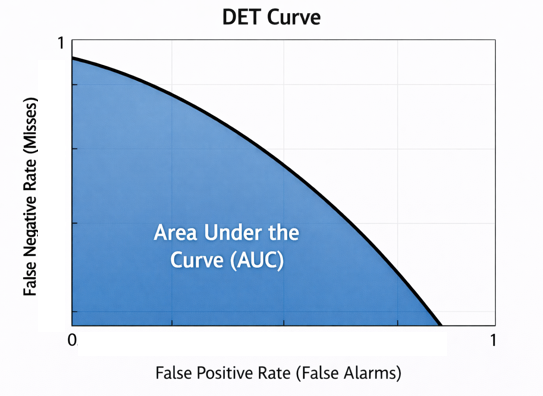
We use the Area-Under-the-Curve (AUC) of the Detection Error Tradeoff (DET) depicted in Fig. 1 as a performance metric. We recall that DET shows the False Negative probability (i.e., the MD) against the False Alarm probability (i.e., the FA). A lower AUC reflects stronger authentication performance and system robustness. The challenger who obtains the lowest AUC wins.
To participate: submit your solution using the submission form.