
Challenge 7: SKG on BRISC Dataset
Abstract
This challenge consists of evaluating the robustness of Secret-Key-Generation (SKG) techniques at the physical layer when a Reconfigurable Intelligent Surface (RIS) is present. Specifically, two devices named Bob and Alice are located in two positions and transmit known pilot signals, allowing them to estimate the channel where an RIS is present. The channel is assumed to be symmetric for uplink and downlink transmissions. Upon the channel estimation, the two devices quantize their estimate with a uniform quantizer, decode their bits using a Low-Density-Parity-Check (LDPC) code, and then apply a hash function on the resulting bitstream. Trudy, on the other hand, is located in a different position and estimates the channel between her and Bob. From this estimate, she aims to guess the maximum number of secret bits extracted by Bob-Alice.
Dataset
The dataset is available at this link: https://doi.org/10.5281/zenodo.18714621.
The Broadband Reconfigurable Intelligent Surface Channel (BRISC) dataset is a large-scale, indoor measurement dataset designed to characterize wireless propagation in the presence of RIS. It provides experimentally collected Channel State Information (CSI) using standard compliant IEEE 802.11ac VHT frames over an 80 MHz bandwidth under a wide range of RIS configurations, enabling realistic evaluation of RIS-assisted communication systems.
Hardware and Experimental Setup The BRISC dataset is collected using synchronized Software-Defined Radios (SDRs) operating at a carrier frequency of 5.53 GHz. The main components of the system are:
- RIS: A programmable metasurface composed of 256 reflecting elements. Each element can be configured in a binary manner (ON/OFF), controlling the reflection of incident electromagnetic waves.
- SDRs: Used at both the transmitter and receiver to generate, transmit, and receive signals. In the experiments two identical Ettus USRP-X310 are used.
- Synchronization System: An OctoClock distribution system ensures phase coherence and time synchronization between all SDR units.
- Antennas: The transmitter uses a single Log-periodic antenna (HyperLOG 60100), while the receiver uses two antennas: a Log-periodic (HyperLOG 30100) and a dipole.
The RIS elements are grouped into blocks to reduce configuration complexity. All elements within a block share the same state, and multiple block sizes are considered.
Measurement Procedure The dataset is generated by systematically varying:
- RIS configurations: either blocks of 64 elements are considered, resulting in a partition of the RIS into 4 blocks, or configurations using varying block sizes that divide the RIS into 9 blocks. For these two partitions, a total number of 24 + 29 = 528 configurations is explored. Finally, random configurations are set, reaching a total number of 10k configurations.
- Transmitter positions: a total number of 9 transmitting positions are explored, as depicted in Fig. 1.
- Pilot transmission: for each transmitting position and RIS configuration, approximately 100 packets are transmitted, thus approximately 100 CSI estimates are provided.
Challenge Description
The software needed for data processing is available at this link: https://github.com/MattiaP1999/BRISC_RIS_dataset_scripts.
Bob is located in a fixed position, and Alice can be located in multiple positions, namely [p1, …, p9], as shown in Fig. 1. Bob selects configurations according to a distribution to derive secret bits: this distribution can be uniform, or optimized to maximize the mutual information or key capacity.
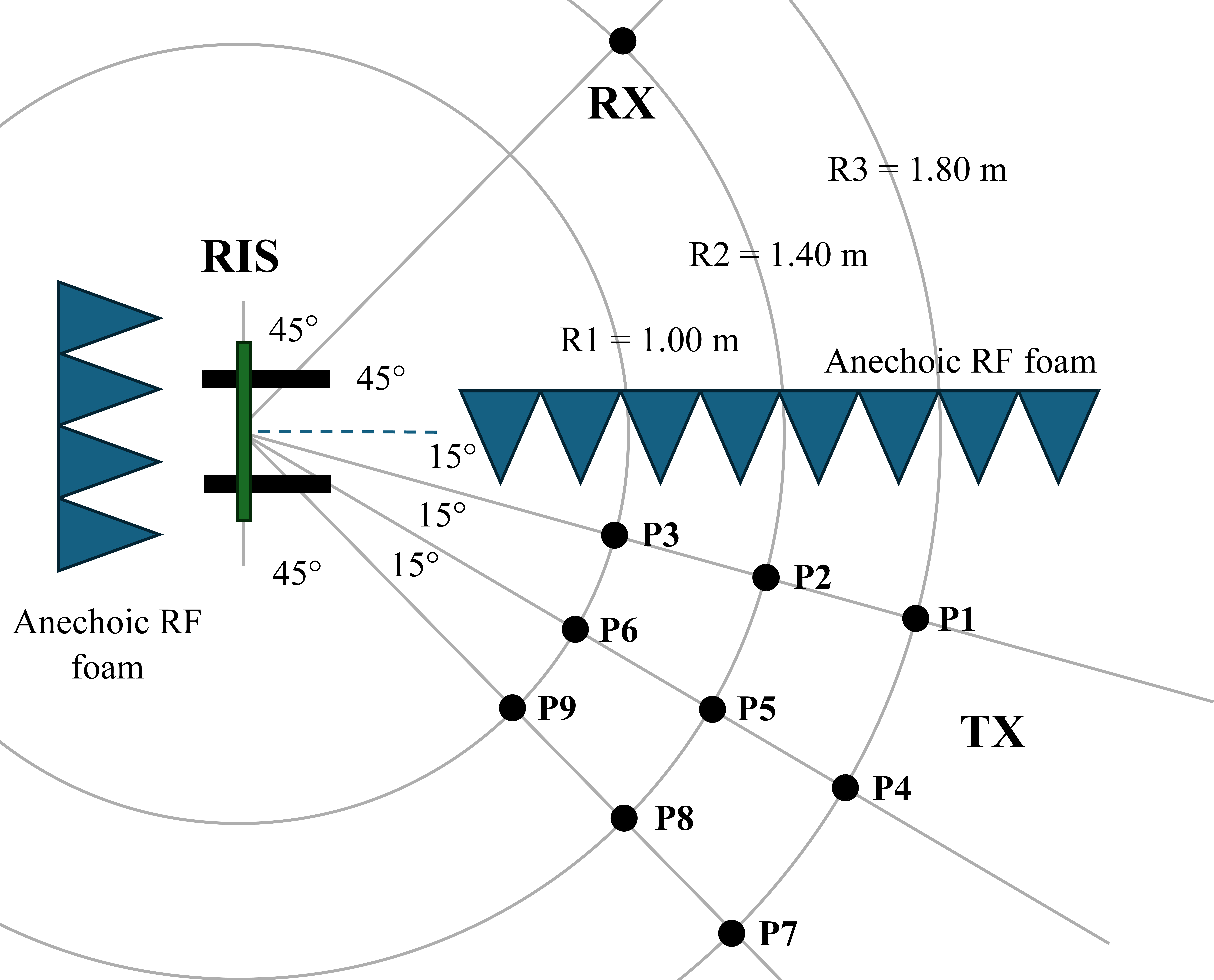
Methodology The procedure for converting the physical channel estimate into bitstreams is the following. Let hB(Φ, p, n) ∈ CNs, where Ns = 242 is the number of subcarriers, be the measured channel vector by Bob with the RIS configuration Φ when Alice transmits from position p at frame n. Assuming reciprocity of the wireless channel, we model the channel measured by Alice when Bob is transmitting as hA = hB(Φ, p, n′), with n′ ≠ n, which is taken from the dataset. This is equivalent to having a reciprocal channel with a different noise realization.
The bit extraction then is as follows:
- Bob measures the channel hB and, for each subcarrier, quantizes it with a uniform quantizer with K levels. Doing so, he attains a sequence of quantized channels {qs = [QK(ℜ(h(s)B)), QK(ℑ(h(s)B))]T}, s = 1, …, Ns, where ℜ(·) and ℑ(·) are the real-part and imaginary-part operators, respectively.
- The quantization levels are mapped into bit sequences using a Gray code, and concatenated together (horizontally). In formulae, Bob attains the sequence b = [b1, …, bNs]T ∈ [0, 1]2KNs where bs = [G(q(0)s), G(q(1)s)] and then the corresponding bit sequences are decoded with an LDPC code.
- The LDPC syndrome is then forwarded back to Alice, in clear, and she will correct her bits to end up in the same codeword as Bob.
- A hash function is finally applied to those decoded bits, and the output is the key.
Eve, positioned elsewhere in another position of Figure 1, has access to the channels corresponding to Bob’s chosen configurations and attempts to reconstruct the key.
Input and Output
Each participant will be given:
- Eve’s channel measurements and the corresponding bits extracted by Alice-Bob, which follow the pipeline previously explained, for a set of RIS configurations (training set).
- The hash function and LDPC code to use for extracting bits from channel measurements.
Each participant should provide the bit sequence associated with Eve’s channel, such that it is as close as possible to Alice-Bob, for given RIS configurations, as explained below. Moreover, they should provide well-commented code and an explanation of the proposed solution.
Evaluation Metric
Using Eve’s channels, the participant must be able to recover the bits that Alice-Bob extracted. In particular, the participants will have a new dataset (testing dataset) containing Eve’s channels for unseen RIS configurations, and the corresponding key bits Alice-Bob extracted. The winner is the participant who attains the highest accuracy, defined as the number of correctly recovered secret bits on the test set. The current best score will be made available in a leaderboard.
To participate: submit your solution using the submission form.